This month's proposal is a conscious descent into the interior of the Marina Alta, a territory where the landscape is not shown all at once, but is revealed little by little. The route runs through three small towns and three caves that can be visited that allow us to understand the region from a less superficial point of view: that of geology, that of human history and that of daily life in the valley.
The itinerary begins in Benidoleig, with the Cova de les Calaveres; continues towards Atzúbia, with the Cova del Canelobre; and ends in the Vall d'Ebo, with the Cova del Rull.
It is a route for interpreting the territory: understanding why these towns are where they are, what explains the subsoil of the landscape and how the long history continues to influence the current way of life.
A BIT OF HISTORY. We know where we come from to decide where we are going.
The Marina Alta caves are the result of a very slow process: water filtering through a limestone landscape over thousands of years. But, unlike an inert natural archive, these cavities have been inhabited, explored and interpreted by people from prehistory to the present day.
Refuge, ritual space, place of passage or simple curiosity: the caves explain a continuous relationship between humans and a difficult environment. And the towns that surround them —mostly of Andalusian origin— are heirs to a history marked by the Christian conquest, the expulsion of the Moors in 1609 and the subsequent repopulation, which completely redefined the demography and economy of the interior.
Benidoleig is at the foot of the Seguili mountain range, in a strategic point that provides an unbeatable panorama of the entire plain of the Girona River with the Segària mountain range in the background. The municipality borders the municipalities of Alcalalí, Beniarbeig, Benimeli, Orba, Pedreguer, el Ràfol d'Almúnia, Sanet i els Negrals, and Tormos.
The first human remains are found in the cave of les Calaveres, with remains 100,000 years old —Upper and Middle Paleolithic— and others from the Bronze Age and Ibero-Roman. Also in the partida de les Plantades there is evidence of a Roman oil press that would be part of a possible Roman villa between the 1st and 5th centuries AD. However, it was the Muslim era that shaped the current town. The origin is in an old farmhouse that, together with another that has disappeared, called Alcúdia, facilitated the settlement of Muslims in these lands back in the 10th century.
Regarding Atzúbia-Forna, the two towns retain an important legacy from the Bronze Age and the Ibero-Roman civilizations that populated them. However, the origin of the towns is Muslim, as we see in the place names. According to Coromines, Atzúbia would correspond to the word zubia, which means 'the hole' or 'enclosed land'; while Forna would come from the Arabic form fúrna ('narrow and dark').
There are many legacies left by the Muslim population: in place names, in urban planning, etc. The village of Forna was converted into a barony at an early stage and is surprising for the magnificent state of conservation of the town, which retains all the charm of medieval Andalusian farmhouses, presided over by the castle-palace, which inside houses original graffiti from the 15th century. L'Atzúbia stands out for its network of streets and spacious houses from the 19th century, and for a beautiful fountain of Moorish inspiration in the square. Without forgetting the scenic value of Xillibre —or Gelibre, as they call it in L'Atzúbia— at the top, the castle of Benirrama to the west of the town and the cave of Canelobre, hidden in the Tossal del Llop.
To find the first signs of human settlements in the Vall d'Ebo, we will have to visit one of the most important Paleolithic sites in the entire province of Alicante. The Fosca cave, considered the Sanctuary of the Paleolithic, dates back to the Magdalenian period with 16,000 years of antiquity where different panels of engraved rock art appear. More prehistoric rock art has also been found in the area such as the Reinós cave (15000 BC) or the Torrudanes cave with Levantine art from 1800 BC. In addition, various scattered materials from the Neolithic, Chalcolithic or Bronze Age have appeared.
The birth of the current urban center in this valley were the various Andalusian farmhouses that developed there in the Muslim era. In the Vall d'Ebo, there were three farmhouses: Villars, Benissuai and Serra. Villars and Benissuai joined to form the current urban center of Ebo.
Tips for the routes
- Bring comfortable shoes and water.
- Respect nature and architectural remains.
- For more information, consult the tourist offices.
SUGGESTED DAYS. Step by step we make our way.
Benidoleig
Stage 1: Benidoleig - Cova de les Calaveres
The Cova de les Calaveres is one of the cavities with the most historical charge in the region. It has two distinct parts: a flooded area, linked to the hydrogeological system, and a dry area that can be visited. Its name comes from the discovery of human bones in an 18th century exploration, a fact that aroused both scientific interest and popular imagination.
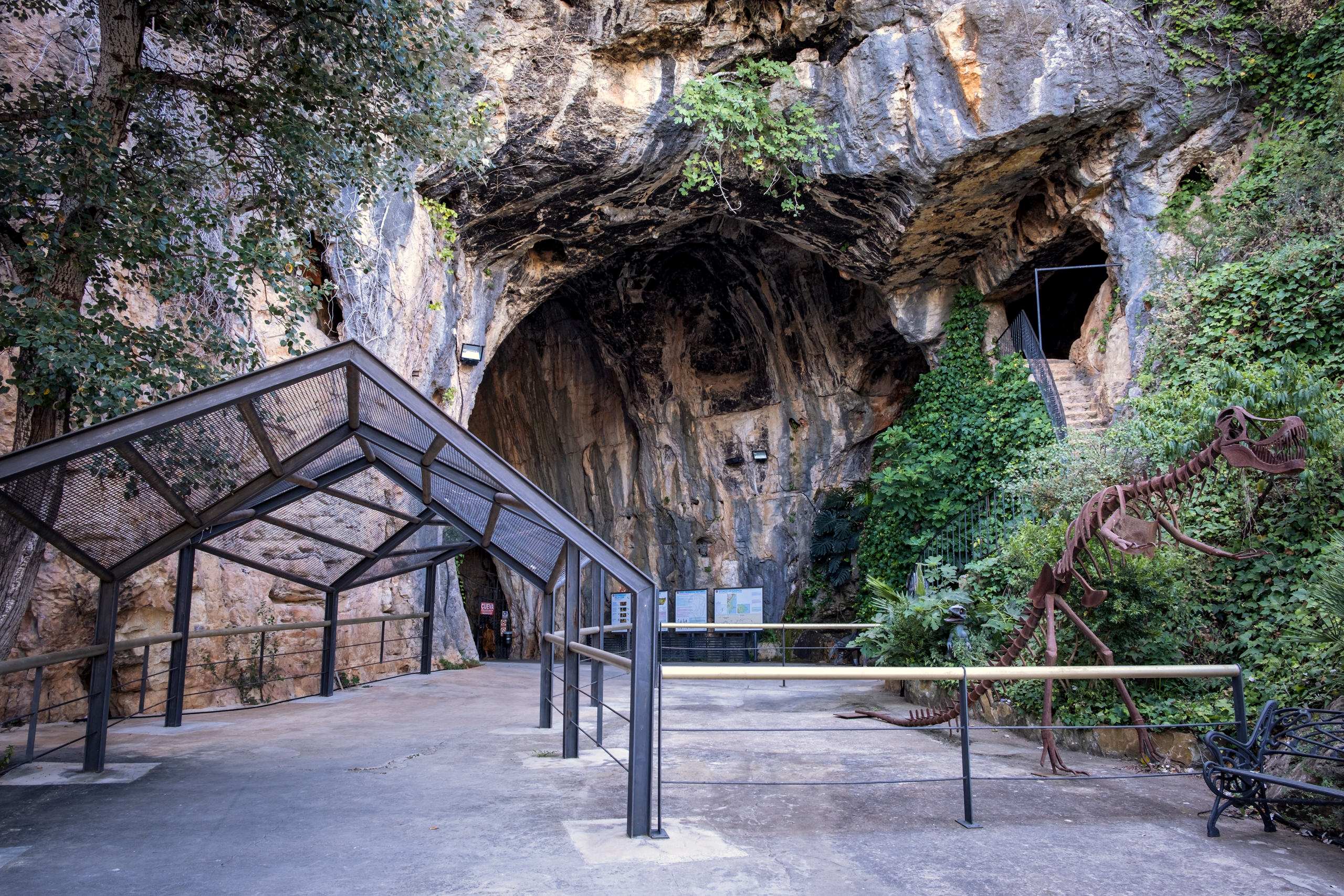 Cova de les Calaveres.
Research has documented human use since prehistoric times, as well as the presence of remains of ancient fauna. It is a cave that not only shows geological forms, but clearly speaks of a continuous use of the territory over thousands of years.
After the visit, walking through the town helps to situate the cave within a real human landscape, not as an isolated element. In addition, we could take the opportunity to visit Ca'l Durà, a 19th century construction, in ruins.
L'atzúbia-Forna
Stage 2: L'atzúbia-Forna - Cova del Canelobre
Cova del Canelobre is a relatively short but very intense cavity. The route, of about 80 meters, includes a drop in altitude that accentuates the sensation of entering the underground world. The large interior room, with hundreds of square meters, is full of stalactites and stalagmites that create an almost "cathedral" image.
Unlike the Cave of Skulls, here the main value is geological and visual: it allows you to understand very clearly how water has shaped the rock over millennia. It is an ideal cave for a short but very evocative visit.
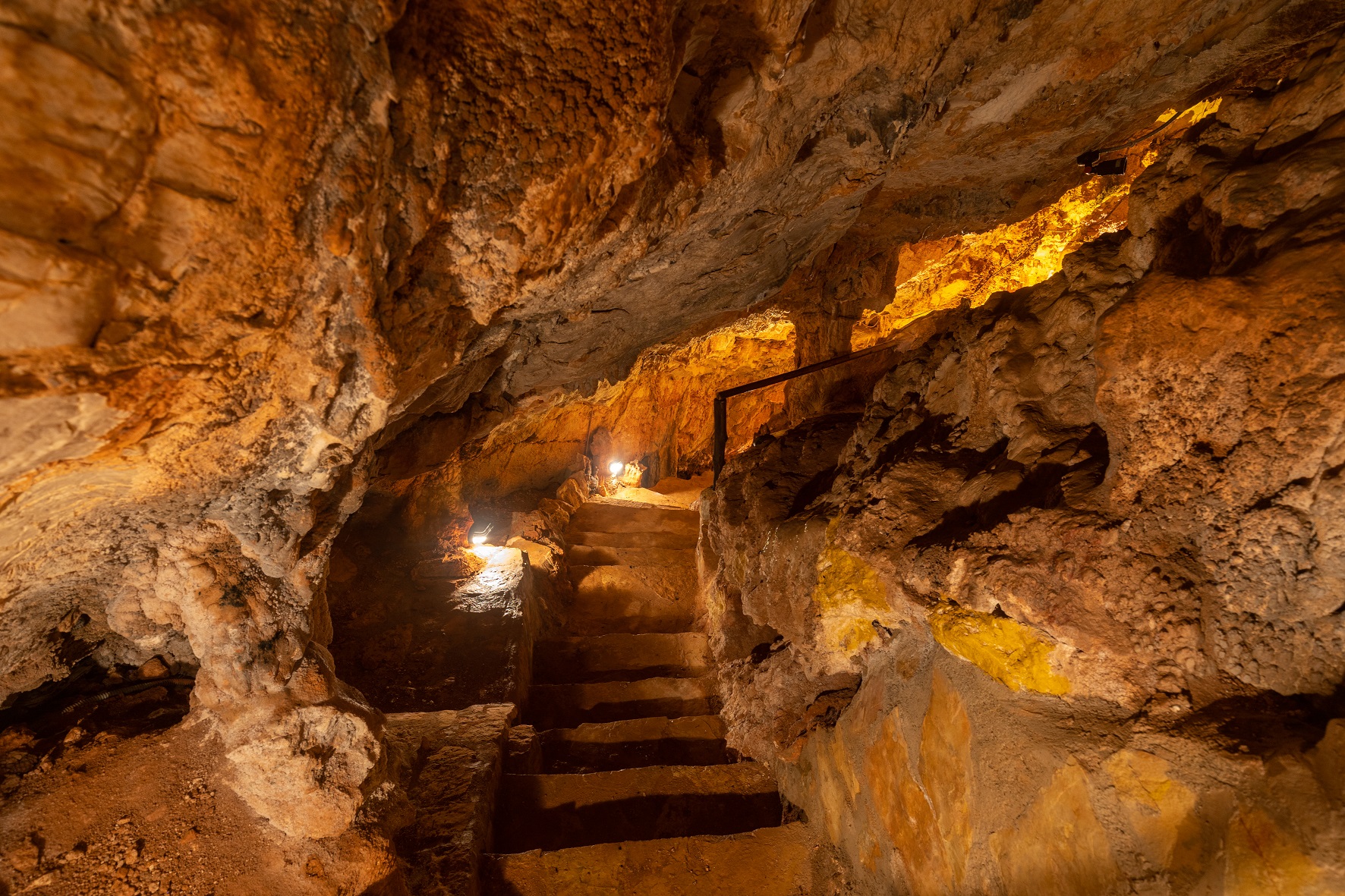 Cova del Canelobre.
When we finish, it is highly recommended to visit the Forna Castle. The castle is organized around a central courtyard and is protected by four towers at the ends. Some authors point to an early tower from the Almohad period (late 12th century – early 13th century). As we can see, it is a quadrangular construction with two floors that is formed around this central courtyard. On the ground floor, the communal rooms are concentrated (studies, kitchen, prison, guardhouse and oil press), while the upper floor is the noble floor or private floor of the lords.
La Vall d'Ebo
Stage 3: La Vall d'Ebo - Cova del Rull
The Cova del Rull has a history closely linked to the town. It was discovered in 1919 by José Vicente Mengual, known as "Uncle Rull", while he was hunting. From the mid-20th century, the cavity was prepared for visits, becoming a benchmark for inland tourism.
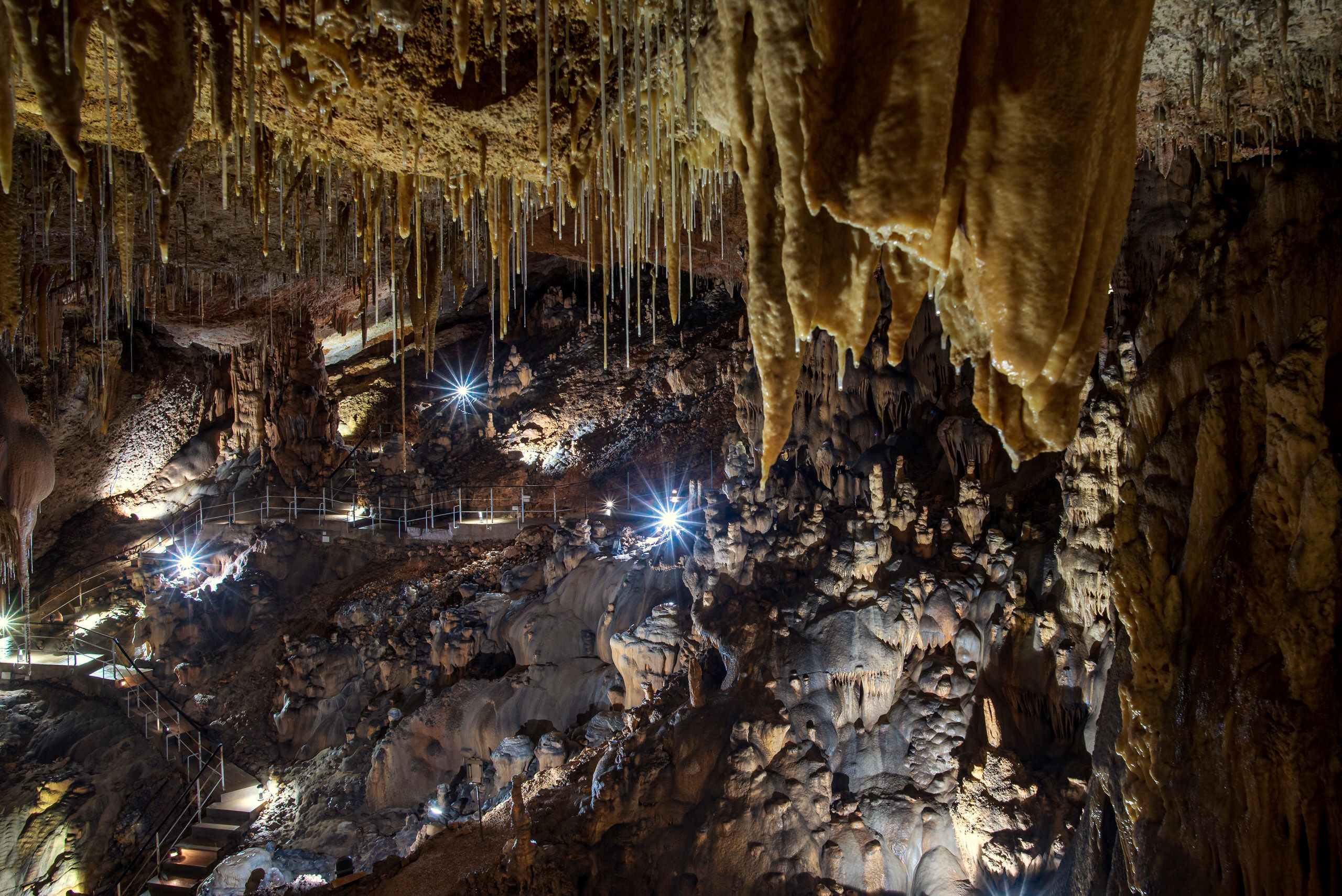 Cova del Rull.
It stands out for its wide variety of speleothems —stalactites, stalagmites, columns and large rooms— and for its comfortable route that allows for a very complete experience in a short time. It is a cave that shows well how natural heritage can be integrated into local life without losing its value.
A key element of the town's identity is the Fira del Perelló, dedicated to a local variety of pear, which is usually held in November and reinforces the link between territory, agriculture and community.
To make the most of your visit to the town, we recommend visiting its Ethnological Museum and Rock Art Interpretation Centre. Located in an old house on Avinguda de la Marina Alta, it exhibits a collection of tools and curiosities contributed by the town's residents. Through these objects, we recreate the life of our ancestors: the austerity of the kitchen tools shows a simple diet, the rudimentary farming tools with which the fruit of hard work was extracted from the earth, the furniture, the clothes, the ornaments, etc.
This route can be done in one day, but to be able to visit the villages in more depth we consider that it should be done in at least two different days, without rushing. The caves are the common thread, but the true value is to understand how the underground landscape, the history of the villages and the current life form the same story.
Entering a cave is not just a visit: it is a way of learning to look at the territory in greater depth.
AND MORE. At the table and in bed at the first cry.
 Where to buy |  where to eat |
 where to sleep |  Activities and others |